6 Mistakes to Avoid in a CRM Project
Implementing a CRM system can be a game-changing step toward improving customer service and optimizing business processes. However, as with any new technology, there are potential pitfalls that can jeopardize its success. Many business owners underestimate the complexity of a CRM project and make common mistakes that can become both costly and time-consuming.
Imagine you’re building a house. Without a solid blueprint and the right tools, you might discover halfway through the project that the foundation is uneven or the windows don’t fit the walls. The same applies to implementing a CRM system: without a clear strategy and careful planning, you risk ending up with a solution that doesn’t meet your business requirements or deliver the expected results.
6 Common Mistakes in a CRM Project
In this guide, we explore six common mistakes businesses make when implementing a CRM system. From failing to involve employees to neglecting data quality, we’ll show you how to avoid these pitfalls and turn your CRM implementation into a success.
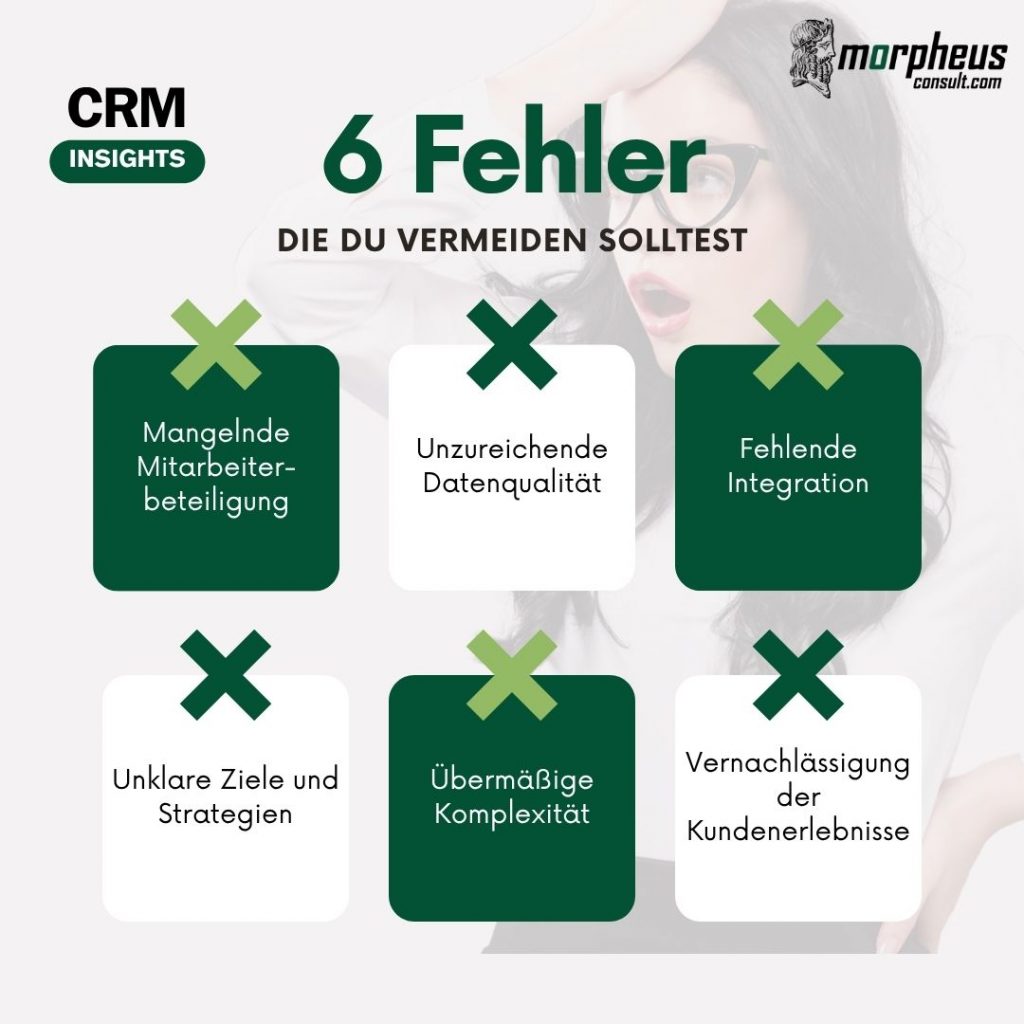
Here are six common mistakes companies make when implementing and using CRM systems:
Lack of employee involvement: CRM systems require company-wide adoption. If employees are not properly trained or do not understand the value of the system, they are unlikely to use it effectively.
Poor data quality: If the data stored in the CRM is incomplete, outdated, or inconsistent, it leads to inaccurate insights and ineffective decision-making.
Lack of integration: A CRM system that is not seamlessly integrated with other business applications (such as email, ERP, or marketing tools) creates data silos and inefficient workflows.
Unclear goals and strategy: Without clearly defined objectives and a CRM strategy, businesses cannot fully realize the benefits of the system. This often results in an investment that delivers little measurable value.
Excessive complexity: An overly complex CRM system can overwhelm users and reduce adoption. A CRM solution should be intuitive, user-friendly, and designed to support employees rather than complicate their work.
Neglecting the customer experience: When CRM systems focus more on internal processes than on improving the customer experience, they fail to achieve their true purpose. The primary focus should always be on creating positive customer interactions.
These mistakes can significantly reduce the effectiveness of a CRM system, negatively impacting customer satisfaction, operational efficiency, and overall business performance.
Das könnte Sie auch interessieren: